


Why AI Interview Preparation Matters in 2025
The Rise of AI Interviews in a Rapidly Evolving Job Market
This year is 2025, and AI interview questions are no longer niche—they’re the new norm. AI is now the lifeline of innovation, not just a buzzword. Whether it’s powering financial forecasts, enhancing healthcare diagnostics, or even writing jokes through chatbots (some better than others), artificial intelligence is transforming industries at lightning speed. And guess what? The job market is scrambling to keep up.
If you’re aiming for a career in AI—be it data science, machine learning engineering, or AI research—your interviews are going to be more complex, smarter, and often AI-driven. Employers today want more than coders. They seek thinkers, builders, and communicators—those who grasp the mission and the math behind intelligent systems.
Here’s the twist: the format of interviews has evolved. Gone are the days of simple algorithm challenges on a whiteboard. Today, you’ll face scenario-based challenges, behavioral rounds, system design problems, and possibly even AI-powered interviews. Yep, it’s entirely possible your interviewer might be an automated system, with a memory sharper than your favorite college professor.
So what can you expect?
This blog dives deep into:
- Real-world AI interview questions from 2025
- Sample answers to ace both technical and behavioural rounds
- A step-by-step prep guide (with humour sprinkled in for sanity)
- Differences in interviews for freshers vs. experienced pros
- The latest hiring trends (hello, LLMs and explainable AI!)
This AI interview preparation guide was created to help you shine, regardless of your level of experience. Also, you are not required to commit the entire scientific learning library to memory. You must, however, display your experience, think clearly, and communicate effectively.
One neuron at a time, we will decipher the algorithm for AI interview questions.
Understanding the AI Interview Landscape in 2025: Trends & Interview Types


Since the days of “Tell me about yourself” and “What’s your biggest weakness?” interviews have changed considerably. By 2025, AI interviews will be far more advanced, intelligent, and technologically advanced. Not only are you being analyzed, but machine learning models that are trained to recognize tone, pauses, and even confidence are literally analyzing you.
What does an advanced AI interview entail, then?
Trends Reshaping AI Interviews in 2025
- Generative AI is everywhere. Expect questions on LLMs like ChatGPT, Gemini, Claude, and open-source tools like LLaMA.
- AI ethics and explainability are hot topics. Can you design a model and explain its decision to a regulator? You better.
- Interviews now assess how well you can work with and deploy AI, not just build it.
- Expect multi-round interviews—technical, behavioral, product-focused, and sometimes AI-led
Interview Types You’ll Encounter
- Technical Rounds: Data structures, algorithms, system design, model tuning, cloud deployment (yes, DevOps is in too).
- Behavioural Rounds: Think STAR (Situation, Task, Action, Result) but tailored for AI projects.
- Scenario-Based Interviews: “Design an AI system for real-time traffic management” or “How would you deal with bias in a facial recognition app?”
AI Tools in the Hiring Process
Many companies now use:
- ATS systems (Applicant Tracking Systems) that rank resumes using NLP.
- AI interview bots that simulate human recruiters.
- Tools like HireVue, InterviewBuddy, or Rezi AI for mock interviews and resume analysis.
Pro Tip: Use these tools yourself. Practicing with AI can help you beat AI.
Knowing how AI is applied in the interview process is as important to success in 2025 as knowing how to create AI. Take some time to process that.
Core AI Concepts Every Candidate Should Know
Now, we are going to get specific. These ideas have importance if you are applying for any position including artificial intelligence. It’s like going to a rap battle without bars if you do not recognize them.
What is Artificial Intelligence?
AI is a broad field, but interviews love to test how well you understand the types of AI:
- Reactive Machines: No memory, no learning. Think IBM’s Deep Blue.
- Limited Memory: Learns from historical data. Most machine learning models fall here.
- Theory of Mind (not widely built yet): AI understands emotions and thoughts.
- Self-Aware AI (still science fiction): The holy grail. Sentient machines. Not yet, thank goodness.
Interview Question Example: “Explain the difference between reactive and limited memory AI with examples.”
AI vs. Machine Learning vs. Deep Learning
These terms often confuse even experienced devs:
- Artificial Intelligence is the umbrella term.
- Machine Learning (ML): A subset of AI where systems learn from data.
- Deep Learning (DL): A subset of ML using deep neural networks to model complex patterns.
- Analogy: deep learning is the attractive spicy topping, machine learning (ML) is a slice, and AI is the entire pizza.
AI Use Cases in 2025
Interviewers love real-world applications. Mention these in your answers:
- Healthcare: Predictive diagnostics, medical imaging, personalized medicine.
- Finance: Fraud detection, algorithmic trading
- Retail: Recommendation systems, inventory forecasting
- Robotics: Autonomous vehicles, drones
- HR & Recruiting: AI-powered screening (like your interviewer!)
Connect your interview preparation to use cases unique to your industry. It displays your understanding maturity and receives you additional points.
Pro Tip: Read blogs like LookingForResume for the latest updates on resume and AI job tips.
Most Common Machine Learning Interview Questions (with Answers)

A large number of AI systems are constructed on machine learning, which is also an important point of exchange in almost all AI interviews. You will gain important credibility in this section whether you are applying as a data scientist, machine learning (ML) engineer, or artificial intelligence (AI) product manager.
1. Supervised, Unsupervised & Reinforcement Learning
You will be asked to describe how these three important learning paradigms differ from one another. Here’s how to give a simple, assured response:
“What’s the difference between supervised, unsupervised, and reinforcement learning?”
Answer:
- Supervised Learning uses labeled data. It learns a function from inputs to outputs. Think: classification or regression problems (e.g., spam detection).
- Unsupervised Learning deals with unlabeled data. It finds hidden patterns or groupings. Think: clustering (e.g., customer segmentation).
- Reinforcement Learning is about learning through trial and error. An agent interacts with an environment, gets rewards, and learns a policy. Think: robotics, gaming, self-driving cars.
Tip: Give real-world examples for each to show practical understanding.
2. Common ML Algorithms (SVM, Decision Trees, KNN, Random Forest)
Expect direct questions like:
“Which machine learning algorithm would you choose for a classification task and why?”
Be ready to talk about:
- SVM (Support Vector Machines): Good for high-dimensional data.
- Decision Trees: Easy to interpret, good for explainability.
- KNN (K-Nearest Neighbors): Simple, lazy learning algorithm for small datasets.
- Random Forest: Ensemble of trees, great for reducing overfitting and improving accuracy.
Pro Tip: Mention trade-offs. For example, Random Forests are accurate but less interpretable than single decision trees.
3. Model Evaluation (Precision, Recall, F1 Score, Confusion Matrix)
This is where measurements and theory come into contact. Your ability to select the correct measure for the correct issue is what interviewers are looking for.
“How do you evaluate a machine learning model?”
Key points to mention:
- Accuracy isn’t always enough—especially for imbalanced datasets.
- Precision: % of true positives among predicted positives.
- Recall: % of true positives among actual positives.
- F1 Score: Harmonic mean of precision and recall.
- Confusion Matrix: Great for visualizing performance across all classes.
Example:
“In a fraud detection model, I’d prioritize recall to catch as many fraudulent cases as possible, even if it means a few false positives.”
4. Overfitting vs Underfitting, Bias-Variance Tradeoff
In this section you can prepare for both situations and academic subjects questions.
“What is overfitting and how can you prevent it?”
Overfitting = model memorizes training data, performs poorly on unseen data.
Underfitting = model is too simple, fails to capture patterns.
Solutions for Overfitting:
- Cross-validation
- Regularization (L1/L2)
- Dropout (for neural nets)
- Pruning (for trees)
Bias-Variance Tradeoff:
- High Bias = underfitting
- High Variance = overfitting
- The goal is to strike the right balance (low total error).
5. Feature Engineering & Data Preprocessing
This is a chance for you to show your practical abilities. Anticipate:
“How do you handle missing values or outliers?”
Good answers include:
- Imputation techniques: mean, median, mode, KNN imputation
- Outlier detection: z-scores, IQR, visualizations (box plots)
- Encoding: one-hot, label encoding for categorical variables
- Scaling: MinMaxScaler, StandardScaler, especially for algorithms sensitive to feature magnitude (like SVM or KNN)
Bonus: Talk about feature selection techniques like:
- Recursive Feature Elimination (RFE)
- LASSO regularization
- Mutual Information
Deep Learning and Neural Network Interview Questions (with Answers)

Deep learning is growing as an increasing area of interest as AI develops, particularly in fields like speech recognition, computer vision, and natural language processing. You should prepare for the main deep learning interview questions covered in this section.
1. Basics of Neural Networks (Perceptron, Activation Functions)
“Explain how a neural network works.”
Answer:
- At its core, a neural network is made up of layers of interconnected nodes (neurons).
- Each neuron performs a weighted sum of inputs, passes it through an activation function (like ReLU, Sigmoid, or Tanh), and outputs a result.
- The network learns by adjusting weights through backpropagation using an optimization algorithm (e.g., gradient descent).
Example Activation Functions:
- ReLU (Rectified Linear Unit) – Most commonly used, solves vanishing gradient problem.
- Sigmoid/Tanh – Older; can saturate and slow learning but still used in certain contexts.
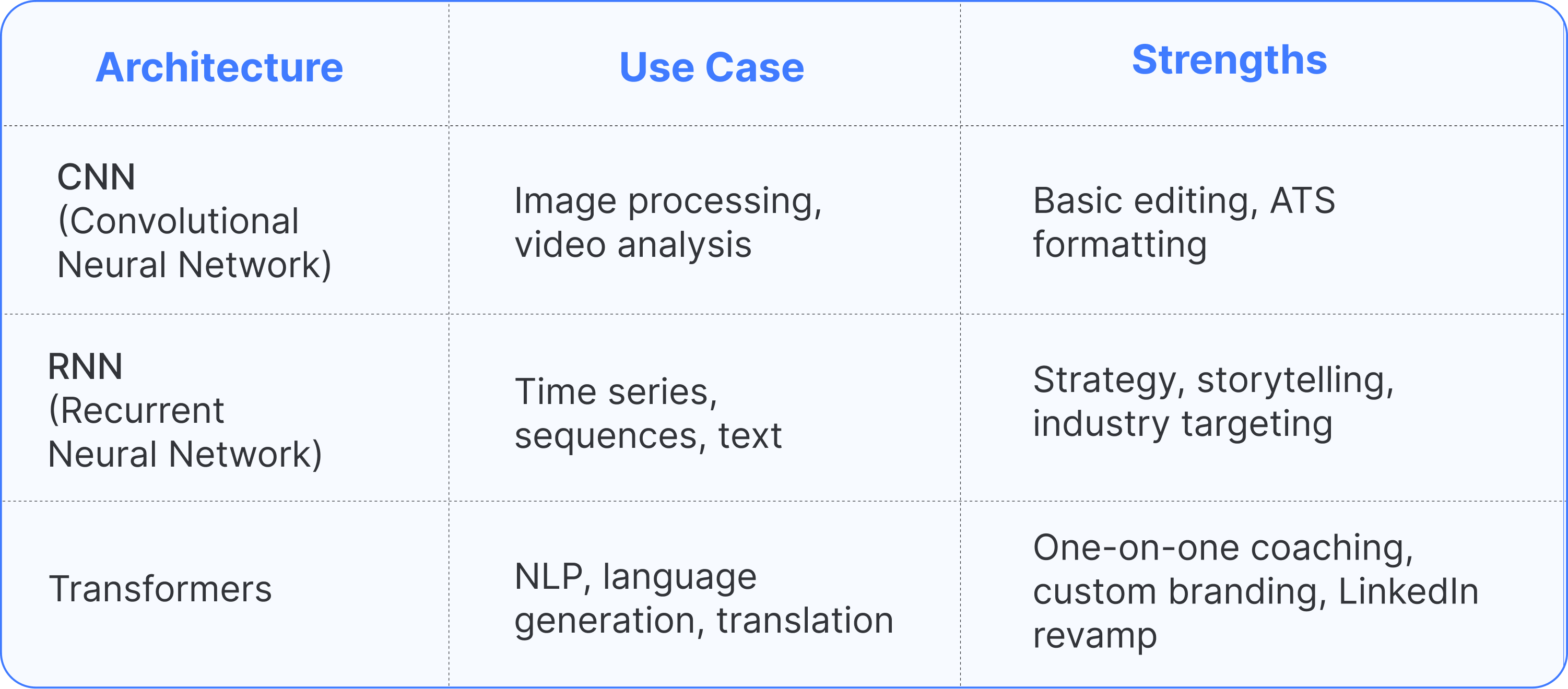
2. CNNs, RNNs, Transformers – When and Why to Use Them
“What’s the difference between CNNs, RNNs, and Transformers?”
Answer:
| Architecture | Use Case | Strengths |
| CNN (Convolutional Neural Network) | Image processing, video analysis | Spatial hierarchy, local feature extraction |
| RNN (Recurrent Neural Network) | Time series, sequences, text | Temporal data, memory of past inputs |
| Transformers | NLP, language generation, translation | Parallel processing, long-range dependency modeling (used in GPT, BERT) |
Tip: Show knowledge of real-world applications. E.g., “Transformers like BERT/GPT are the backbone of modern NLP systems.”
3. Overfitting in Deep Learning & Regularization Techniques
“How do you avoid overfitting in deep learning models?”
Answer:
- Dropout: Randomly disable neurons during training.
- Early stopping: Stop training when validation loss increases.
- Data augmentation: Increase dataset variability (esp. in image data).
- Batch normalization: Stabilizes and speeds up training.
- L2 Regularization: Penalizes large weights.
Pro Tip: Mention using learning curves to visually inspect overfitting.
4. Loss Functions & Optimization Algorithms
“Which loss function would you use for classification problems?”
Answer:
- Binary classification → Binary Cross-Entropy
- Multi-class classification → Categorical Cross-Entropy
- Regression → Mean Squared Error (MSE), Mean Absolute Error (MAE)
“What optimization algorithms have you used?”
Answer:
- SGD (Stochastic Gradient Descent): Simple, effective for large-scale learning.
- Adam: Adaptive learning rate, great for most problems.
- RMSprop: Good for recurrent networks and non-stationary objectives.
5. Transfer Learning & Fine-Tuning Pretrained Models
“Have you used transfer learning?”
Answer:
Actually. For identifying images, I used transfer learning to work with trained CNNs such as ResNet and VGG. To adjust the model to my dataset, I changed the higher layers and kept the lower layers. On small datasets, it increased accuracy and reduced training time.
Common Pretrained Models:
- Image: ResNet, Inception, EfficientNet
- NLP: BERT, GPT, RoBERTa
Top Generative AI Interview Questions (GPT, DALL•E, and More)

With the rise of ChatGPT, MidJourney, and DALL·E, expect cutting-edge questions on generative AI.
1. Prompt Engineering Basics
“What is prompt engineering?”
Answer:
The ability to create specific inputs to get desired outputs from large language models (LLMs) like GPT is known as prompt engineering. It uses methods such as:
- Role prompting (“You are an expert AI interviewer…”)
- Chain-of-thought prompting (“Let’s think step by step…”)
- Few-shot prompting (providing examples)
Interviewer information: You may be asked to improve a particular quick or live-demo prompt engineering.
2. Differences: GANs vs Diffusion Models vs Transformers
| Model Type | Purpose | Example |
| GANs (Generative Adversarial Networks) | Generate realistic images, videos | StyleGAN |
| Diffusion Models | Progressive noise-to-image generation | DALL·E 2, Stable Diffusion |
| Transformers | Text generation, understanding | GPT, BERT, Claude, Gemini |
Tip: Since diffusion techniques are used to create high-quality images, it has become popular to understand how they operate.
3. Applications in NLP, Image Generation, and Code
“Give real-world applications of generative AI.”
Answer:
- Text: Chatbots, summarizers (e.g., ChatGPT, Claude)
- Image: AI art, product mockups (e.g., MidJourney, DALL·E)
- Code: AI pair programmers (e.g., GitHub Copilot)
- Video: Deepfakes, synthetic avatars
AI Interview Questions for Freshers vs. Experienced Professionals
AI interview questions often vary depending on your level of experience. Understanding what interviewers focus on for freshers compared to experienced professionals can help you tailor your preparation effectively.
1. AI Interview Questions for Freshers: Concepts and Coding Basics
The hiring managers usually analyse new hires’ basic understanding of AI and machine learning concepts. They may ask about your experience with small projects or internships, algorithms, and statistical concepts.
Key Areas for Freshers:
- Understanding of supervised and unsupervised learning
- Basic knowledge of popular algorithms (e.g., linear regression, decision trees)
- Coding skills in Python or relevant languages
- Hands-on projects from coursework or internships
- Data preprocessing and exploratory data analysis
Sample Question for Freshers:
“Explain the difference between supervised and unsupervised learning.”
Sample Answer:
“Supervised learning trains models that predict outcomes, such as identifying emails as email or not, using labelled data.” Unsupervised learning identifies hidden patterns, like client segmentation, in raw information.
2. AI Interview Questions for Experienced Professionals: System Design & Deployment
more deeply knowledge of technology is expected of experienced candidates, which includes handling real-world data challenges, developing scalable AI systems, and using models in production settings.
Key Areas for Experienced Professionals:
- Designing end-to-end AI pipelines
- Handling large-scale datasets and data engineering
- Model optimization and tuning in production
- Dealing with deployment issues (model drift, latency)
- Leadership and mentoring roles
Sample Question for Experienced:
“How would you design a recommendation system for a large e-commerce platform?”
Sample Answer:
“For better suggestions, I would initially look at user behaviour and product metadata before selecting mutual filtering combined with content-based filtering. I would process data using scalable technologies like Apache Spark, record model performance after deployment, and use A/B testing to confirm improvements.”
3. Sample Answers for Different Levels
| Question | Fresher Sample Answer | Experienced Sample Answer |
| What is overfitting and how do you prevent it? | “Overfitting happens when the model learns noise instead of patterns. Techniques like cross-validation, regularization, and pruning help prevent it.” | “In production, I monitor model metrics continuously to detect overfitting. I apply regularization techniques, early stopping, and periodically retrain models with fresh data.” |
| How do you handle missing data? | “I use methods like mean imputation or removing rows with missing values.” | “I analyze the missingness pattern first, then use advanced imputation techniques like KNN imputation or modeling-based approaches.” |
AI Behavioral Interview Questions & How to Answer Them
In AI interviews, knowledge of the technology is important, but behavioural questions are just as important. These questions analyse your communication, teamwork, range of motion, and problem-solving techniques. Being ready for them can help you stand out from the competition.
1. STAR Method for Behavioural Questions
A tried-and-true framework for arranging your answers in a clear effective manner is the STAR method:
- Situation: Describe the context or background.
- Task: Explain the challenge or responsibility you faced.
- Action: Detail the steps you took to address the task.
- Result: Share the outcome or impact of your actions.
Allowing a short, connecting story with quantitative results is made easier when you use STAR.
2. Sample Behavioral Questions
-
Describe a time you solved a technical challenge.
- Situation: “During my internship, we faced an issue where our model’s accuracy dropped unexpectedly.”
- Task: “I was tasked with identifying the cause and fixing the problem.”
- Action: “I analyzed the data pipeline and discovered that recent data had a lot of missing values. I implemented improved data cleaning and retrained the model.”
- Result: “Model accuracy improved by 15%, and the issue was resolved for future runs.”
-
How do you stay updated with the latest AI trends?
- Situation: “In the rapidly evolving AI field, staying current is essential.”
- Task: “I needed to find efficient ways to keep up with new developments.”
- Action: “I regularly follow AI research papers on arXiv, subscribe to industry newsletters, participate in AI webinars, and contribute to open-source projects.”
- Result: “This practice helps me bring innovative ideas to my projects and stay competitive in interviews.”
3. How to Showcase Soft Skills + Tech Skills
- Communication: Clearly explain complex technical concepts in simple terms.
- Teamwork: Highlight experiences collaborating with cross-functional teams.
- Problem-Solving: Emphasize your analytical thinking and creativity.
- Adaptability: Show how you learn new tools or adjust to changing requirements.
- Passion: Demonstrate enthusiasm for AI through personal projects or continuous learning.
You become an applicant who is prepared to contribute successfully when you connect these soft skills with your technical knowledge.
How to Answer Scenario-Based AI Interview Questions
By needing you to apply your knowledge to actual issues, scenario-based questions analyze your practical understand of AI concepts. These questions additionally measure how well you can explain difficult concepts.
Real-Life Use Case Prompts
- How would you use AI to optimize crop yield for farmers?
Here, the interviewer wants to see your grasp of AI applications in agriculture, data usage, and solution design.
- Design an AI-based fraud detection system.
This assesses your ability to architect AI systems that detect patterns and anomalies effectively.
- How would you explain facial recognition to a non-tech stakeholder?
This tests your communication skills and ability to simplify technical concepts.
How to Structure Answers: Clarify → Approach → Trade-offs
When answering scenario questions, follow this structure:
- Clarify: To completely understand the problem’s constraints and scope, ask questions. What kind of crops, for instance? What information is at hand? Who are the users?
- Approach: Describe the AI methods or formulas you would employ. You might think about combining climate prediction models with imagery from space analysis for the crop produce example.
- Trade-offs: Talk about the restrictions, difficulties, or moral dilemmas. Mention false positives, data privacy, or the frequency of model retraining for fraud detection.
How to Discuss Your AI Projects in Interviews: Tips and Best Practices

When interviews, you can differentiate yourself from competitors by showing your AI projects in an effective manner. It displays not only your knowledge of technology but also your effect and interpersonal skills.
Structuring Your Response: Problem → Solution → Tech Stack → Results
When discussing your AI projects, follow this clear framework:
- Problem: Briefly describe the challenge or objective your project addressed.
- Solution: Explain your approach, including any AI models, algorithms, or techniques you used.
- Tech Stack: Highlight the tools, programming languages, and platforms involved (e.g., Python, TensorFlow, scikit-learn).
- Results: Share measurable outcomes such as accuracy improvements, efficiency gains, or business impact.
Using GitHub or Portfolio to Present Real Work
Interviewers may look at your code, documentation, and project structure by linking to your GitHub repository or online portfolio. Make sure your collections are arranged properly, with examples and READMEs that are easy to understand.
Tips to Prepare Demos or Walkthroughs
- Prepare a concise demo: Show a live or recorded walkthrough of your project to demonstrate functionality.
- Anticipate questions: Be ready to explain design choices, challenges faced, and lessons learned.
- Practice: Rehearse your presentation to keep it clear and engaging under time constraints.
Quick AI Interview Preparation Tips and Checklist for 2025
- Revise core AI and machine learning algorithms and key terminology.
- Practice coding challenges focusing on Python, NumPy, and TensorFlow.
- Stay updated with the latest AI research papers, frameworks, and tools.
- Prepare 2–3 personal AI projects you can confidently discuss in detail.
- Practice mock interviews using platforms like ChatGPT, InterviewBuddy, or peers.
Conclusion & Resources for Further Learning
Preparing for AI interviews requires more than just technical knowledge—it demands a strategic mix of AI interview preparation guides, real-world project experience, and the ability to communicate your problem-solving approach clearly. To boost your chances of success, review common interview formats, practice scenario-based coding problems, and refine your personal AI projects so you can discuss them confidently.
Equally important is staying current in this fast-paced field. The world of AI is evolving rapidly, so continuous learning isn’t optional—it’s essential. Whether you’re brushing up on machine learning concepts, exploring prompt engineering, or improving your AI resume, consistent upskilling will keep you ahead of the curve.
To help you on this journey, check out our curated list of free AI courses and tutorials. For ongoing tips, strategies, and deep dives into interview techniques, visit our LookingForResume Blogs—your go-to resource for everything from AI resume tips to mock interview breakdowns.
Your future in AI starts with one smart step. Keep learning, keep growing, and stay prepared to succeed in 2025 and beyond.
FAQS
Q1: What are the top AI interview questions in 2025?
In 2025, AI interview questions focus on machine learning algorithms, deep learning, NLP, prompt engineering, and ethical AI. Expect a mix of technical challenges, real-world scenarios, and questions on AI project implementation
Q2: How should I answer AI interview questions?
Use the Clarify–Approach–Trade-offs (CAT) method for technical questions. For behavioral questions, follow the STAR method and share real project examples to showcase your problem-solving and collaboration skills.
Q3: What skills do I need to crack AI interviews in 2025?
Essential skills include Python, machine learning, TensorFlow, PyTorch, data preprocessing, and ethical AI. Employers also value communication skills, teamwork, and domain knowledge in healthcare, fintech, or robotics.
Q4: How can I explain complex AI concepts in interviews?
Explain AI concepts using real-life analogies and simple language. For example, describe neural networks like the human brain or use Netflix’s recommendation engine to explain collaborative filtering.
Q5: What is the career outlook for AI jobs in 2025?
AI careers in 2025 are booming. Roles in AI ethics, healthcare AI, robotics, and automation are in high demand. Upskilling in generative AI and staying current with trends boosts your job prospects.
CALL TO ACTION
Want to make a stellar first impression before the interview even starts? Grab our FREE AI-optimized resume template—specially designed to pass ATS filters and highlight your AI skills effectively.
Frequently Asked Questions About AI Interviews in 2025
Q1: What are the top AI interview questions in 2025?
In 2025, the most common AI interview questions cover areas like machine learning algorithms, deep learning frameworks, NLP, prompt engineering, and ethical considerations in AI. You’ll often face a blend of technical problem-solving questions, real-world case studies, and project-based discussions.
Q2: How should I answer AI interview questions?
Use the CAT method (Clarify–Approach–Trade-offs) when tackling technical questions. For behavioral questions, apply the STAR method (Situation–Task–Action–Result) and support your answers with real examples from AI projects you’ve worked on.
Q3: What skills do I need to crack AI interviews in 2025?
To succeed in 2025 AI interviews, you’ll need strong skills in Python, TensorFlow, PyTorch, machine learning, data preprocessing, and ethical AI frameworks. Also, soft skills like teamwork, problem-solving, and communication are critical — especially in cross-functional or domain-specific AI roles.
Q4: How can I explain complex AI concepts in interviews?
To make complex AI topics easy to understand, use analogies and relatable examples. For instance, compare neural networks to how the human brain learns, or use Netflix’s recommendation system to explain collaborative filtering. Clear, simple language is key — avoid excessive jargon.
Q5: What is the career outlook for AI jobs in 2025?
The AI job market is thriving in 2025, with growing demand in areas like healthcare AI, robotics, AI ethics, and automation. Upskilling in generative AI tools and keeping pace with evolving technologies will significantly boost your career opportunities.