


So, you’ve got your heart set on working abroad? Maybe the romance of Parisian cafes, the dynamism of Hong Kong’s skyline, or the laid-back vibe of Sydney is calling to you. Whatever your reason, finding a job in the global job market requires more than a nicely written domestic resume. You need an international resume – a resume that values and is sensitive to the nuances of international recruitment procedures. This book is your Rosetta Stone to creating a resume that will be attractive to employers across borders.
Why International Resumes Are Different (And Why You Should Care)
The world is becoming smaller, isn’t it? With increased remote working, increasing migration, and companies going out of their way to employ across the globe, the desire for a global career is closer than ever to being an attainable goal in 2025. However, showing up in the global labour market with your standard CV is akin to turning up at a dinner at an upscale restaurant at night wearing a pair of flip-flops – it just isn’t done.
The International Job Market in 2025: Remote Work & Cross-Border Recruitment Trends:
The face of work is transforming rapidly. Remote work opportunities make you a possibility to live in Jaipur but work for a company in London. Increased migration for professional development and companies proactively searching for talent globally have rendered geographical boundaries obsolete in hiring. Such interdependence necessitates awareness of the nuances of an international CV.
International vs. Domestic Resumes: Key Differences Explained:
You usually tailor your domestic resume to match the expectations and cultural norms of your home country. But when applying internationally, you must adapt your resume to align with the specific standards and preferences of the target country. This can include differences in formatting, the type of personal information included (or excluded), the level of detail expected in your work experience and education sections, and even language conventions.
Cultural & Legal Resume Expectations by Country:
Imagine sending a resume to Germany with a photo, as is standard there, compared to sending the same resume to the UK, where placing a photo on it is generally frowned upon and even deemed discriminatory. Or imagine the difference between a brief, one-page resume favored in Canada compared to a longer international CV standard in Europe. These are cultural and legal expectations that must be respected, and if you do not observe them, your application will automatically be sent to the rejection pile.
What Is an International Resume?
Let us cut to the chase, as they say. What is this shape-shifter document we speak of as an international resume?
Definition and importance for global job seekers:
A global resume is a tailored copy of your business overview designed to meet the specific needs and domestic customs of the country where you’re applying. Its relevance cannot be overstated for global job seekers. It demonstrates that you’ve done your research, honor customs, and are dedicated to working in that country.
Differences from country to country between “CV” and “resume”:
Oh, the age-old “CV vs. resume” issue! In North America (America and Canada), a resume will be a concise, one- to two-page document highlighting proper skills and experience for an application for a particular job. A foreign CV (Curriculum Vitae), which is standard practice in Europe, the UK, and other countries, is often more detailed and longer, and will encompass a full history of your educational and career achievements. Understanding this difference is crucial; providing an abbreviated resume when a more extensive CV is required (or vice versa) is a severe error.
When to use a local resume vs. international resume:
The rule is simple: if you are seeking employment in a nation whose resumes are formatted differently from that of your home country, you need an international format resume. If you are seeking telecommuting employment with a company based elsewhere but they do require their local resume format, use it. When in doubt, discover the target country’s standard resume format.
Key Differences in International Resume Structure by Region

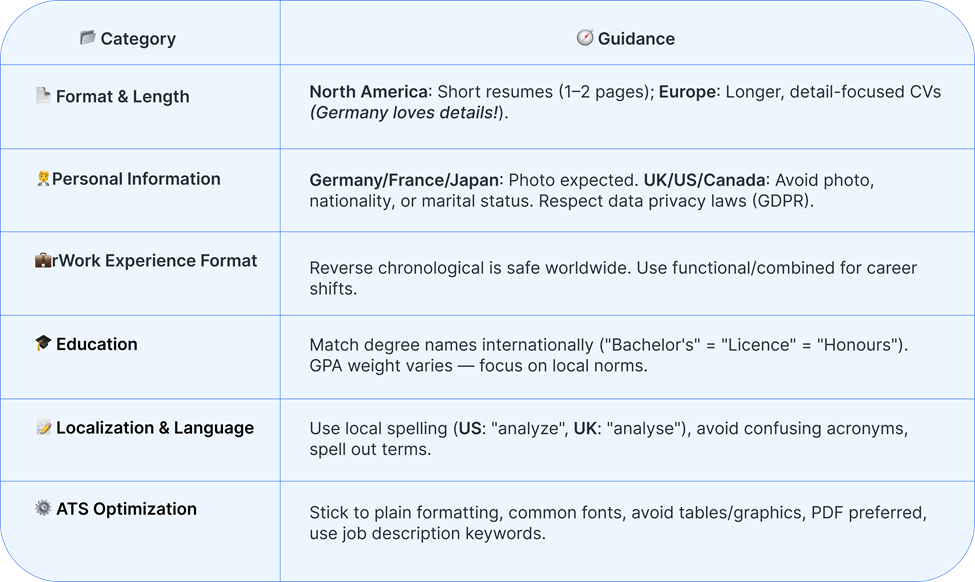
Since grabbing a coffee can vary wildly from Seattle to Italy, so too can resume expectations fluctuate globally. Let’s take a quick tour of some major regional resume format variations.
Format & Length: Short vs. Long Resumes by Country:
In North America, short resumes are typical (one page for lesser candidates, two pages for greater). The majority of Europe and research or scholarship employment globally, however, prefer a longer international resume format or CV that can be over two pages. Germany, for instance, prefers detail-oriented.
Personal Information: Photo, Nationality & Marital Status – What to Put In:
This is a culture minefield. Whereas German, French, and Japanese resume templates include a professional photo as standard or even mandatory, in the UK, US, and Canada, this is generally disapproved of due to potential bias concerns. Including your marital status or nationality also differs greatly. In some European countries, this might be standard, while in others, it’s immaterial and even discriminatory. Always ensure you know what the local norms are for your country of sale. Keep GDPR and data privacy in Europe in mind, which might also restrict what personal data is acceptable.
Work Experience Format:
Functional vs. Chronological by Region: While the reverse chronological is widely accepted, regions will prefer a more functional (skills emphasis) or combined format for career changers or those with non-traditional work experience. Nevertheless, reverse chronological is a safe and universally understandable approach in most international environments.
Education Section:
GPA Differences & Naming Conventions: How you list your education also differs. Knowing international degree equivalences is necessary. For example, a “Bachelor’s” in the US may be equivalent to a “Licence” in France or an “Honours” degree in the UK. Similarly, GPA differs in its significance. In some countries, a particular degree classification (e.g., “First Class Honours” in the UK) is more significant than a GPA.
Localization & Language:
Spelling, Acronyms, Terminology: This might be obvious, but you need to be careful about spelling conventions (UK English vs. US English). Placing “colour” on a US resume or “analyze” on a UK CV can make you look sloppy. Be careful also with acronyms and local terminology. What’s a common abbreviation in your home country might be worthless somewhere else. Always spell out terms the first time.
ATS Optimization:
Global Resume Formatting for Global Applicant Tracking Systems: Just like in your native country, global applicant tracking systems (ATS) are used by most global corporations. Therefore, ATS optimization of global resumes is critical. Apply plain formatting, common fonts, few graphics or tables, and include keywords from the job description. Saving your resume as a PDF is generally safest to ensure consistency across different systems.
How to Write an International Resume: Step-by-Step Guide

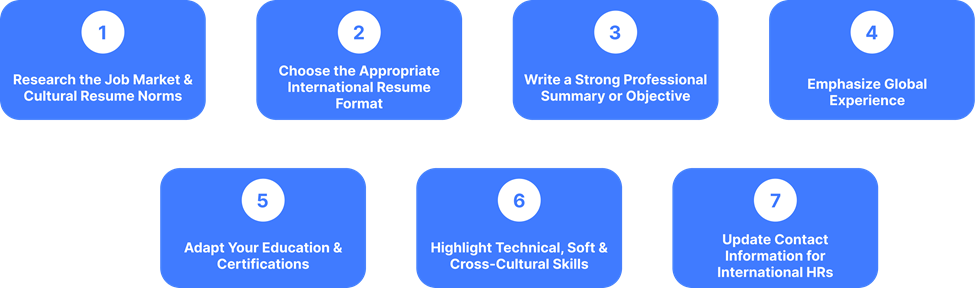
Ready to roll up your sleeves and make a great international resume? Here’s a helpful, step-by-step guide to guide you through the process, no matter what your career status.
Step 1 – Research the Job Market & Cultural Resume Norms:
Don’t even think about formatting until you’re deeply familiar with the job market and cultural resume norms of your target nation. Learn what’s expected in the target nation by reading job postings, studying industry expectations, and even networking with people in your field on sites like LinkedIn. Research local hiring websites and resume databases to observe how local professionals showcase themselves.
Step 2 – Choose the Appropriate International Resume Format:
From what you’ve researched, choose the best one to employ. Chronological, functional, or combination? Do you have to create a short resume or a longer international CV? Being aware of the local preference is essential.
Step 3 – Write a Strong Professional Summary or Objective:
Your professional summary (widespread in North America but increasingly used in other countries) or objective (more traditional, especially for candidates with less experience) should be focused, customized, and adapted. Adapt it to the specific job and use words and expressions that sound meaningful in the target country. For example, a Canadian job description might emphasize more on soft skills and teamwork, while the German one emphasizes technical expertise.
Step 4 – Emphasize Global Experience & Accomplishments:
In describing your work experience, quantify achievements by using worldwide standards whenever possible. When you’ve worked on cross-border projects or have worldwide experience with globally spread-out teams, be certain to emphasize this since it demonstrates flexibility and worldwide mind-sets. Use action verbs and stress outcome, as if writing a home country CV.
Step 5 – Adapt Your Education & Certifications:
List your educational qualifications clearly, using naming conventions from your home country and, where possible, giving the equivalent in the target country (if it is a widely recognized equivalent). Give any relevant certifications, particularly internationally recognized ones.
Step 6 – Highlight Technical, Soft & Cross-Cultural Skills:
Apart from your technical and soft skills, mention globally required communication skills, multi linguality if possible, and knowledge about remote collaboration tools and best practices. These cross-cultural skills are valued the most in today’s global job market.
Step 7 – Update Contact Information for International Hiring Managers:
When giving your phone number, be sensitive to time zones. Use the international dialing code. Keep your email address professional. Your international LinkedIn profile URL is obligatory, as it enables recruiters to know more about your professional experience.
International Resume Examples by Country (2025 Edition)

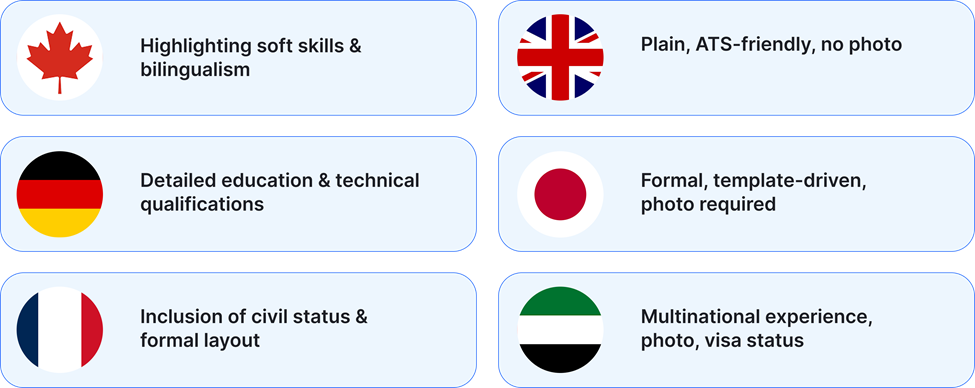
Let’s put on specifics! Here are general guidelines and country-by-country keyword focuses for resume format. Don’t forget that these are wide brushstrokes, and research the specific expectations of your company and industry whenever possible.
-
Canada Resume – Highlighting soft skills & bilingualism:
Canadian resumes usually prefer a summary, one-to-two-page format. Emphasize the soft skills like teamwork, communication, and problem-solving. If bilingual (French and English) is your skillset, highlight them prominently.
-
Resume for Germany – Detailed education & technical qualifications:
German resumes (interchangeably referred to as curriculum vitae) are more detailed, with a photograph and educational qualifications in formalized format. Technical qualifications and skills are highly favored.
-
Resume for France – Inclusion of civil status & formal layout:
French resumes typically include civil status (number of children – though this is less frequent in current times with privacy concerns – marital status) and a formal layout. An office photo typically follows.
-
UK Resume – Plain, ATS-friendly, no photo:
UK CVs (again, used instead of resumes) must be plain, brief, and ATS-friendly. Don’t put a photo, and be careful with UK English spelling.
-
Resume for Japan – Formal, template-driven, photo required:
Japanese resumes (rirekisho) are extremely formal, template-driven and typically require a professional photo. Honesty and precision are highly valued.
-
Resume for the UAE – Multinational experience, photo, visa status:
UAE resumes typically incorporate a professional photograph and can call for visa status. Highlighting multinational company and cross-cultural team experience is helpful.
Personal Information: What You Should (and Shouldn’t) Include
Navigating the waters of placing personal information on an international resume are choppy ones. Here’s a rundown of resume guidelines to work abroad.
- Gender, marital status, DOB: country-specific guidelines: As previously stated, including your gender, marital status, or date of birth is greatly determined by the country. In many European and Asian nations, this may be standard practice, but in the UK and North America, it’s usually left off. Always find out the particular expectations of your target nation.
- GDPR and European data privacy matters: As you conduct interviews to find jobs in Europe, be extremely careful when it comes to GDPR and European data privacy concerns. Showing excessive personal detail which is not absolutely necessary regarding professional qualification could prove to be fishy.
- Talking About Visa Status and Work Permits in Your Resume
Whether you should mention your visa status and work permits depends on the job advertisement and your personal situation. If the employer specifically requests this information or if you already have the legal right to work in the country, it’s a good idea to include it. Doing so can help eliminate any confusion and reassure the hiring manager about your eligibility. If you are not currently holding a work permit, it is typically best to address this later in the application process unless the job explicitly states they don’t sponsor visas.
Resume Writing Tips for Working Abroad
International resume writing is more than formatting and translation. These are some key international resume writing tips.
- Highlighting cross-cultural collaboration: Highlight if you have worked in multicultural teams, managed international projects, or worked with clients from different cultural backgrounds. It shows that you are flexible and globally oriented.
- Changing tone and writing style: The tone and writing style to be employed may vary. There are certain cultures that prefer to be spoken to formally and explicitly, and there are others that might appreciate a relatively more casual style. Learn about the communication etiquette of your target nation.
- With local job titles and spellings: We’ve already touched on spelling, but don’t forget job titles too. What a “Manager” is supposed to do in one nation might be different in another. Use job titles widely recognized in your market.
- Resume dos & don’ts by world region: (This would incorporate a more detailed breakdown of some particular dos and don’ts for some regions, building on the examples of individual countries in the above sections.)
Tools & Resources for Writing International Resumes

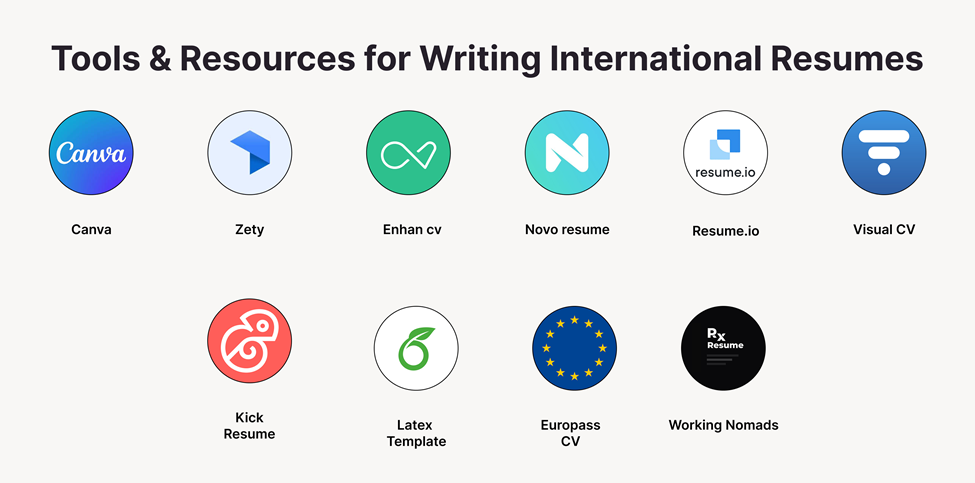
Don’t reinvent the wheel! There are many tools and resources available that can assist you with writing a successful global CV template.
- Best international resume builders (e.g., Canva, Zety, Enhancv): There are various online international resume builder websites that provide templates tailored for international job applications, which usually enable you to select country-specific formats.
- Country-specific resume templates (PDF/Word): Look online for country-specific resume templates. Most career websites and resources provide downloadable templates in PDF or Word format that adhere to local practices.
- Government websites and embassy job boards: Check out government websites and embassy job boards of your country of interest. They typically provide tips on what the local job market expects and even resume writing.
International Resume Template (Free Download)

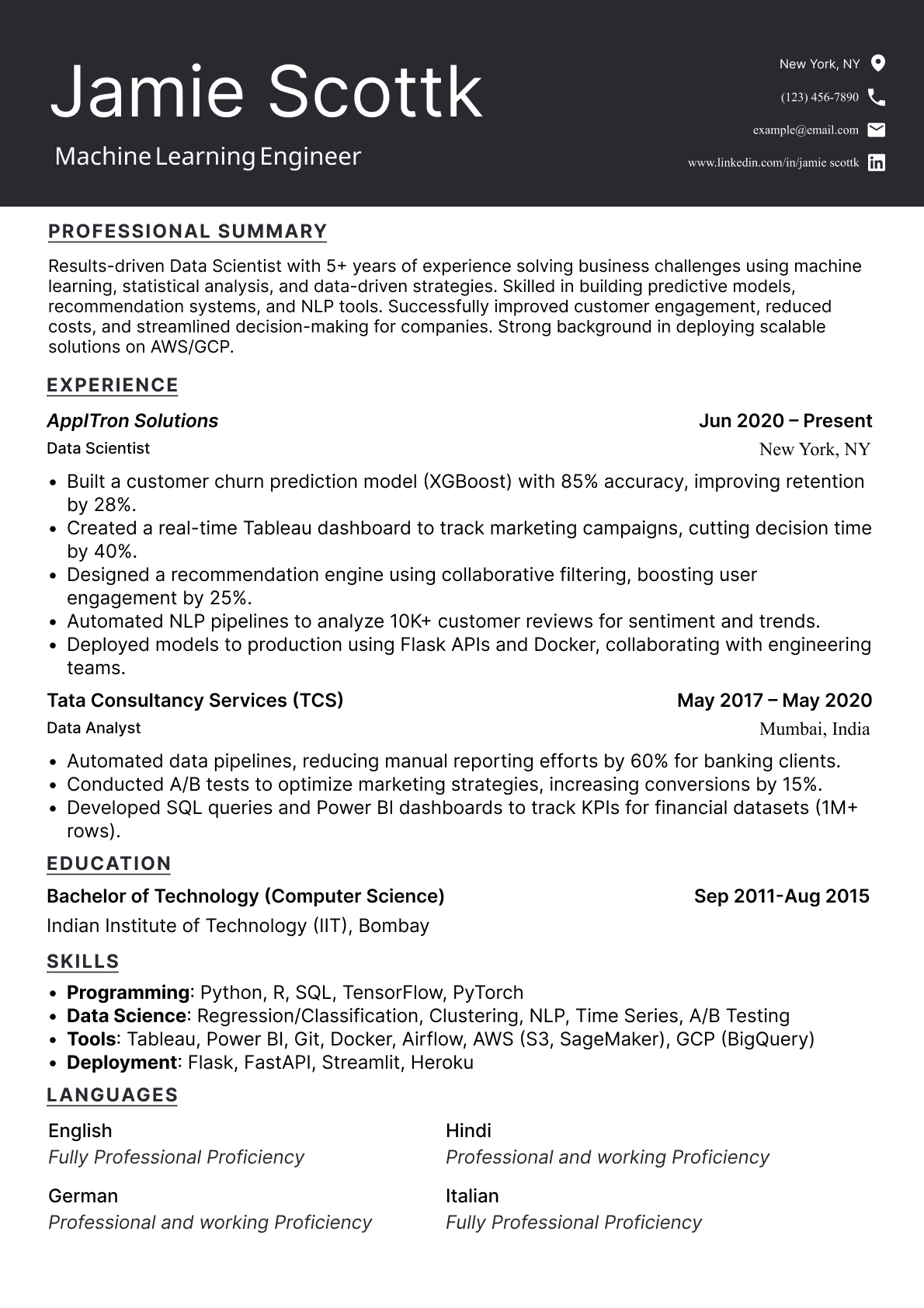
(Again, here you would best put up a link to a professional, editable international resume template in PDF and Word formats and a short explanation of each section and customization tips.)
- Explanation of each section of the template: (Briefly outline the function of each section of the template you are sharing and how it can differ from the standard domestic resume.)
- Best practices for exporting (PDF/Word for ATS compatibility): (Paraphrase the need to save in a PDF so that formatting is consistent but include that older ATS might still prefer Word documents – suggest checking the job posting if you are unsure).
Final Resume Review Before You Submit
You’re almost there! Before you mail off that resume for foreign jobs, take a deep breath and work through this final checklist.
- Regional proofing (US/UK spelling): Double check your spelling and grammar, employing the proper regional English (where appropriate) for your destination country.
- Formatting and font consistency: Ensure that you have consistent formatting throughout the document and that you’ve employed an appropriate and readable font.
- Naming files for recruiters (FirstName_International_CV.pdf, for instance): Employ a plain and professional filename with your name and an indicator that it is for an international application.
- Final worldwide job application checklist: (Offer a concise checklist that covers all the key points covered in the guide, such as tailoring, formatting, personal information, and phrasing.)
Key Takeaways & Action Steps
You’ve navigated the complexities of writing an international resume! Let’s summarize the key points.
- Recap: Global resumes require localization, research, and structure: Keep in mind that a global resume success is not a translation of your home-country resume. You should research local job market traditions, carefully structure the content, and pay close attention to detail.
- Encouragement to use the downloadable template and builder: To make this easier, use the downloadable international resume template and explore the recommended international resume builder tools.
- Pro Tip: Always tailor for the region, company, and role: The most significant lesson here is to always tailor your resume to the target country
CALL TO ACTION
✈️ Ready to Work Abroad? Download Your Free International Resume Template Now at LookingForResume.com!
FAQs
1.How do I format my resume for international jobs?
Research the specific country’s norms; generally, clear, concise formatting is key, and ATS-friendliness is often important globally.
2.Should I include a photo in my international resume?
It varies greatly by country; common in some (like Germany, France, Japan) but discouraged in others (like the UK, US, Canada).
3.Is a CV better than a resume for working abroad?
Employers in Europe and some other regions usually expect a more detailed CV, while those in North America prefer a concise resume.
4.What are the best resume formats for international students?
Focus on skills, education, and any relevant projects or experiences, adapting the format (resume or CV) to the target country.
5.Can I use the same resume for every country?
No, you should tailor your resume to each country’s specific cultural and professional expectations for the best results.
6.How do I write a resume with no international experience?
Highlight transferable skills, relevant projects, and your eagerness to learn and adapt to a global work environment.