
Prompt Engineering for Real Life (Free PDF Guide)


A practical prompt engineering guide for intermediate Claude users who want consistently better outputs, not a theory guide, not a tips list. Covers the five variables every prompt must set (Role, Task, Context, Format, Constraints), five frameworks (RCOS, Chain, Layered, Steelman, Persona), before-and-after examples across six real-world categories, a diagnostic checklist for fixing bad prompts, advanced consistency techniques, and a system for building your own reusable prompt library. Includes a one-page quick-reference repair checklist. Free PDF download.
Terms of use:
- Free for personal use only
- No attribution required
- No resale or redistribution
- No commercial use
Read the full Licensing Information
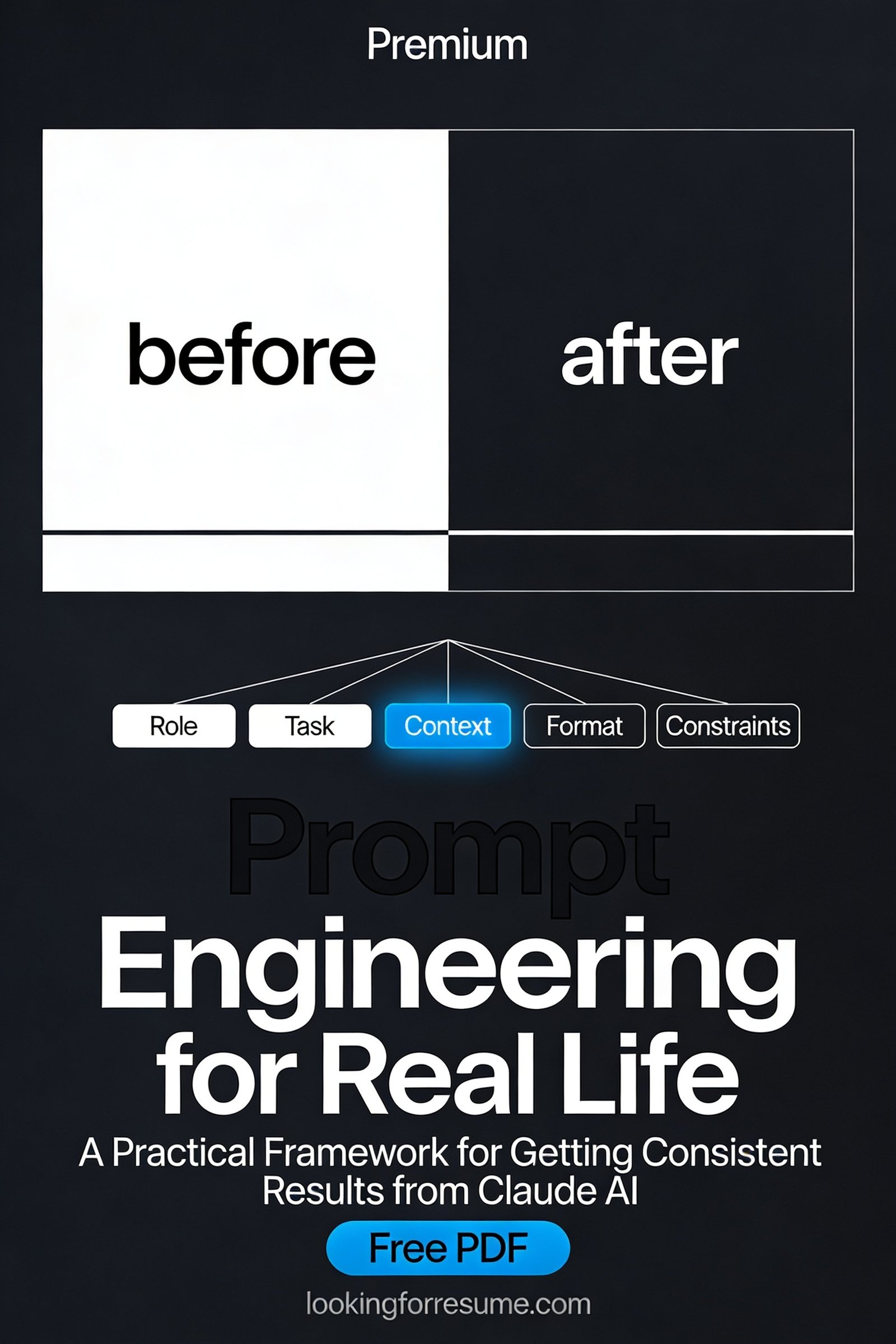
Prompt Engineering for Real Life is a structured methodology guide for anyone who uses Claude AI regularly and wants to move beyond trial-and-error prompting to a system that produces reliable, high-quality outputs.
What is inside:
- Chapter 1: How prompts actually work, the pattern activation principle and what it means for your instructions
- Chapter 2: The five variables that control every response: Role, Task, Context, Format, and Constraints with weak vs. strong examples for each
- Chapter 3: Five frameworks RCOS, Chain prompting, Layered prompting, Steelman, and Persona with complete examples and when to use each
- Chapter 4: Real-world before-and-after examples across six categories: professional email, research summary, content outline, data analysis, content rewriting, and planning
- Chapter 5: Fixing bad prompts: eight failure patterns with specific diagnosis and repair instructions
- Chapter 6: Prompting for specific output types analytical frameworks, comparative analysis, persuasive content, templates, and summaries
- Chapter 7: Advanced techniques priming, reasoning-first, example-based standards, scope fencing, structured self-review, and negative examples
- Chapter 8: Building your personal prompt system: what to capture, how to organize, and how to improve prompts over time
- Appendix: Quick-reference prompt repair checklist, a one-page diagnostic to use whenever an output is not what you needed
Who this is for:
Freelancers, marketers, writers, consultants, and professionals who use Claude regularly and want to produce higher-quality outputs with fewer revision cycles. Intermediate level, assumes you use Claude already and want to improve.
What makes it different:
This guide teaches diagnosis and methodology not a list of prompts to copy. You leave with a framework you can apply to any task, on any topic, immediately.
Download your free copy from lookingforresume.com.
Related products








Practical Guides.
Real Tools. Real Growth.
Actionable AI guides, productivity tools, and career growth strategies to help you learn, grow & achieve more.
Explore Premium
Guides on Gumroad
In-depth guides, templates & premium resources to accelerate growth.
➜
Practical guides.
Real tools.
Real results.
Let’s grow together!